Reliable Optical Communication in LEO Satellite Constellations
Fast Steering Mirror Solutions for Acquisition, Tracking, and Disturbance Compensation under Dynamic Conditions

Free-space optical communication (FSOC) enables high-data-rate intersatellite links in low Earth orbit (LEO) constellations. Achieving stable optical connections under dynamic orbital conditions requires highly precise beam control.
A recent development project required a space-qualified fast steering mirror for use in FSO terminals that would also be suitable for high-volume production. The goal was to ensure reliable optical link stability while complying with stringent requirements regarding mass, mechanical footprint, environmental robustness, and scalability.
From the outset, both dynamic performance and manufacturability at constellation scale were treated as equally critical. As with all PI projects, the collaboration started with a comprehensive requirements engineering phase to gain a deep understanding of the specific fit, form, and functional needs.
Maintaining Optical Links in Dynamic LEO Environments
In LEO constellations, optical terminals must continuously maintain precise beam alignment despite platform-induced disturbances. At the same time, each mission presents unique and highly specific requirements.
Due to the extremely narrow optical beam, even minor pointing deviations can lead to link degradation or loss.
This requires:
System-Driven Engineering Approach
Development is based on application-specific system requirements (fit, form, and function).
Solutions are designed in close collaboration with the customer starting with the early stages of system definition, ensuring alignment across design, validation, and industrialization.
The approach focuses on robust performance under real operating conditions, while addressing both dynamic behavior and production scalability as equally critical design drivers.
Key design drivers:
- Dynamic platform behavior
- Integration constraints within the optical system
- Environmental requirements for launch and in-orbit operation
- Scalability to high-volume production (hundreds of units per month)
Concept Evaluation: Balancing Travel Range, Dynamics, and Integration
Multiple actuation concepts were evaluated without predefined technology bias, based on angular travel, dynamic bandwidth, resolution, mechanical integration, and manufacturability at scale.
The assessment focused on overall system suitability within the optical application context rather than optimizing a single performance parameter.
While alternative concepts offered advantages such as higher resolution, their achievable angular range was limited relative to the defined acquisition and tracking requirements.
The final design decision balanced usable angular range, dynamic performance, and integration constraints instead of prioritizing peak resolution alone. In FSO systems, usable angular range directly defines acquisition capability.

Solution of Choice: Voice-Coil Fast Steering Mirror
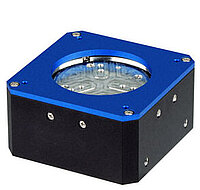
The chosen solution is a customized >> V-931 voice-coil-driven fast steering mirror optimized for space deployment and scalability.
Key characteristics include:
- Up to 60 mrad angular travel
- >50 Hz frequency at full travel
- Compact design with a system weight of approx. 140 g
- Closed-loop control enabling µrad-level resolution
- Mechanical design prepared for automated assembly
This configuration supports reliable beam acquisition and stable tracking in dynamic conditions.
Validation Under Space-Relevant Conditions
Performance limits were validated using simulation-driven design and prototype testing, including laboratory, shaker, and durability evaluations under representative environmental conditions. This approach reduced technical risk prior to final design freeze.
Scalable Production for Constellation Deployment
The system is designed not only for performance, but for reproducibility across large-scale deployments.
Constellation-scale production built in:
- Automated assembly and calibration
- Automated measurement of relevant specifications
- End-of-line verification
- Unit-level traceability
Production capacity: several hundred units per month
System Performance in Real Deployment
The resulting system enables reliable optical communication under real operating conditions and supports deployment across large satellite constellations.
This ensures reliable performance not only at component level, but across fully deployed satellite constellations.